
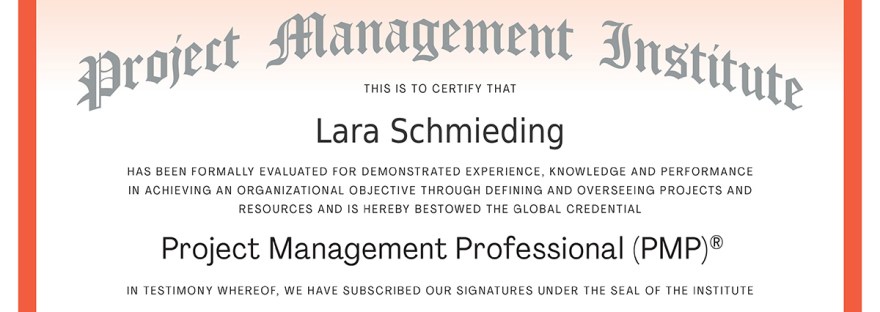
As a newly certified PMI project manager, I hope this post is helpful to others seeking the accreditation. I want to caveat that this advice is based on the exam when I took it. Please reference PMI for the most up-to-date information.
What is the PMP?
PMP stands for Project Management Professional. This is a professional certification given by the Project Management Institute, a global organization of project managers. You can find additional information at PMI.org.
Who is eligible to take the PMP exam?
Before applying for your exam, make sure you meet the eligibility requirements.
- A four-year degree
- 36 months leading projects
- 35 hours of project management education/training or CAPM® Certification
OR
- A high school diploma or an associate’s degree (or global equivalent)
- 60 months leading projects
- 35 hours of project management education/training or CAPM® Certification
How do I get my 35 training credit hours?
You can get your PDUs from a variety of PMI accredited education programs or trainings.
I wanted in-person training so I attended The University of Texas at Austin’s Center for Professional Education’s “Project Management Certification Program”. This is an 8-week course aimed to prepare you for the exam and provide real examples of project management. During this course, you form a team and build a project plan from scratch. By the end of the course, you are asked to present your project in front of a panel of PMP certified project managers. I enjoyed this course but it is not necessary for getting your PMP.
A more cost effective option is this LinkedIn Learning course titled “Cert Prep: Project Management Professional (PMP)”. I actually took this course as well when studying for my exam.
How do I fill out the PMP application?
You can start the application process by creating an account with PMI.
Before going through the application with PMI, I’d recommend writing out all of your projects in a spreadsheet. Here is a link to the template that I used to keep track.
What study materials should I use?
There are many options when you begin to study for the PMP. These are the resources I utilized and would recommend. Everyone learns differently so feel free to find other resources via a Google search.
A Guide to the Project Management Body of Knowledge PMBOK Guide – You need to read this. It’s boring, but you gotta do it. All of our exam questions will come from the information in this book.
Rita Mulcahy’s PMP Exam Prep – I purchased the ebook version. I read this book cover to cover once, taking the chapter assessments as I went. This book is great because it breaks down the PMBOK into easy to understand concepts, has exercises to test your knowledge, and contains tips for passing the exam. For each end of chapter quiz, I recommend reading through the reasoning for each answer, even if you got those questions correct. I took extensive notes and re-read those notes at least 3 times. I also re-read chapter 2-3 again a couple of weeks before my exam.
PMP Exam Simulator – This is an excellent tool when preparing for your exam. You can customize assessments based on areas where you need more practice or take full 200 question exams. I took 3 of the full exams in the month leading up to my actual exam. You get a full breakdown of which questions you missed with explanations on the correct answers and where in the PMBOK to reference for additional details.
What does a brain dump look like?
I took photos of the brain dump I practiced for your enjoyment!
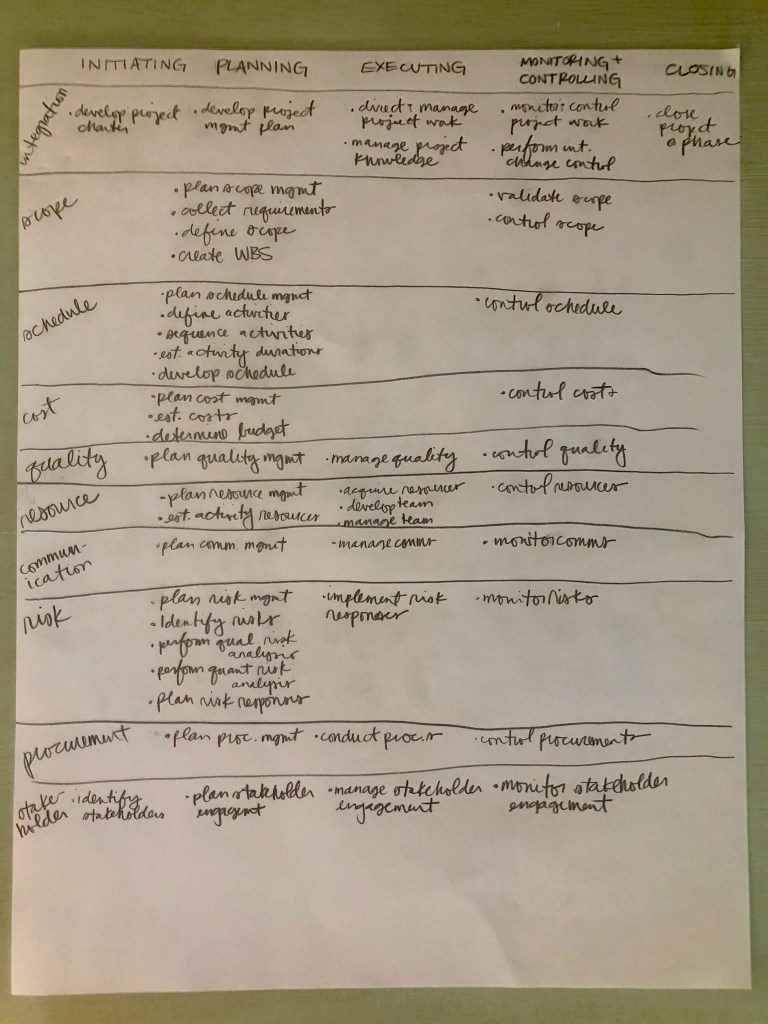

Because I took the exam via online proctor, I ended up not writing down the original front of my brain dump. More on that later.
What’s it like taking the PMP exam via online proctor?
In all honesty, it’s not ideal. However, I do think it’s necessary to prevent the spread of COVID-19.
Make sure you have a Windows machine. The PearsonVUE application does not play nicely with MacOS. I am very glad that I tried this out the Friday before my exam the following Monday. I was able to borrow a friend’s PC and practice on it over the weekend. I highly recommend downloading the application at least the day before your exam to test that it actually works with your system. I did not have any issues the morning of my exam because I worked out all of the kinks over the weekend.
The main downside to the proctored exam for me was the inability to use scratch paper for my brain dump and calculations. You are not allowed to have anything on your desk besides a mouse and keyboard.
You do have access to a “notepad” that works similarly to Microsoft Paint. I practiced creating the full 49 process groups chart but it was taking too much time. I ended up simply opening a single text box and dumping in all of my equations. Let me tell you, trying to go through the algebra using the equivalent of the Microsoft Paint pencil was not easy.

 Lara Schmieding